List of prime ministers of Canada - Wikipedia
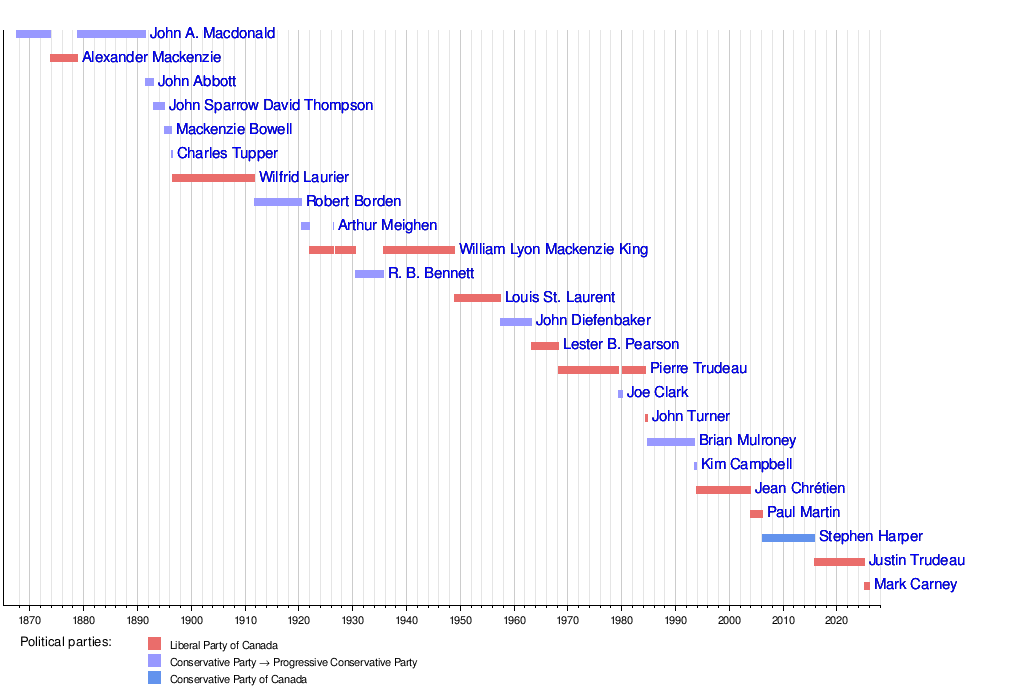
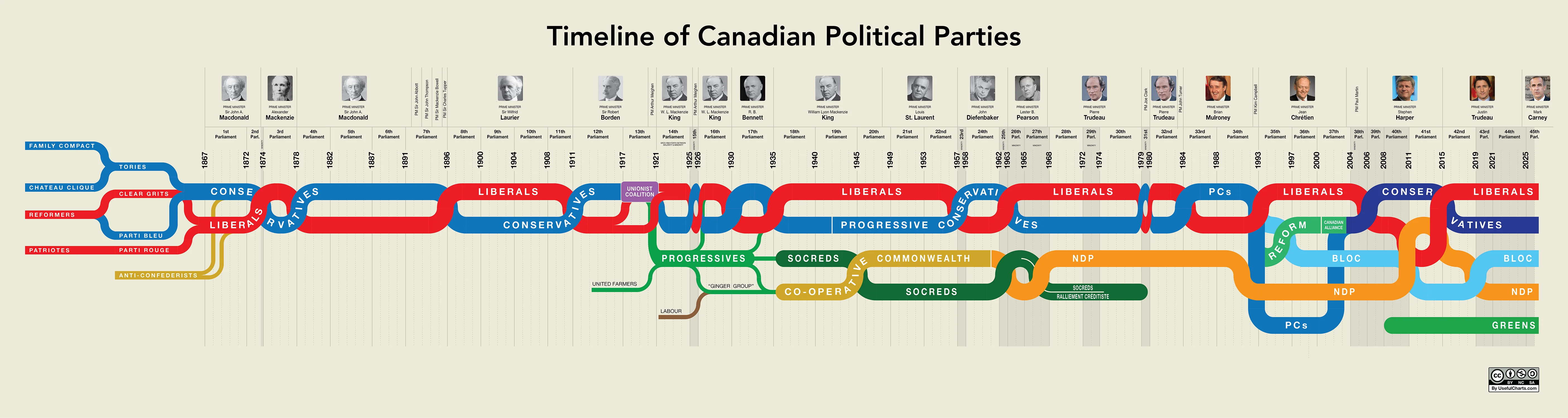
Terms:
- Liberal-Conservative party is a Conservative party
- Historical Conservative parties:
- Liberal-Conservative, Conservative (Historical), National Liberal and Conservative, Progressive Conservative
- Unionist
- Conservative, but a fusion of the Conservatives and the pro-conscription Liberals during WWI
🟦 *John A. Macdonald (Liberal-Conservative)
- 1st PM
- 1st and 3rd cabinet
- 1867 - 1873
- 1878 - 1891
- Remembered for: being the first PM, for gaining Canadian independence, and being a dick to the indigenous
- leading figure in the discussions that lead to the British North American Act and the establishment of Canada as a nation
- expanded Canada by annexing the North-West Territory, Rupert’s Land, British Columbia, and Prince Edward Island
- residential schools and starvation policies (big yikes)
- died in office (stroke)
🟥 *Alexander Mackenzie (Liberal)
- 2nd PM
- 2nd cabinet
- 1873 - 1878
- Remembered for: introducing lasting democratic and institutional reforms, such as the Supreme court
- appointed after the Pacific Scandal
- basically private companies started paying the Conservative party (the party in power). Huge controversy leading to Macdonald resigning and Mackenzie being appointed
- created Supreme Court
- Indian Act
- between the NW Rebellion, hanging Riel, and the Peasant Farm Policy, not a great dude for the Indigenous
🟦 John Abbott (Liberal-Conservative)
- 3rd PM (Appointed)
- 4th cabinet
- 1891 - 1892 (retired)
- Remembered for: Didn’t do a ton tbh
- He kinda snitched about the whole Pacific Scandal thing which screwed Macdonald’s government
- This mf signed on to get Canada to join the US (Montreal Annexation Manifesto). At least he regretted it later in life (he was 28 when he signed it)
- He supported Thompson becoming PM but accepted the party’s wishes (anti-Catholic sentiment)
- Canada faced recession (not his fault?)
- McGreevy-Langevin scandal
- Hector-Louis Langevin (Minister of Public Works) had conspired with Thomas McGreevy (contractor TODO who did what?) to defraud the government
- Failed to negotiate treaty of reciprocity with the US
- Conservatives gained power under him, but what the fuck did this guy accomplish as PM?
- Tried to turn the office over to Thompson but failed again
- Got hit with some brain cancer and retired, so finally Thompson took office
🟦 John Sparrow David Thompson (Liberal-Conservative)
- 4th PM (Assumed office)
- 5th cabinet
- 1892 - 1894
- Assumed office after Abbott resigned
- big hand in enacting the Criminal Code (he was the Minister of Justice)
- Manitoba Schools Question ^1
- this one spills into Bowell’s and Tupper’s terms, and it’s considered a key issue that resulted in the end of the Conservative’s dominance in early Canadian politics
- the Manitoba Act (1870) was supposed to make English and French co-official languages
- the Official Language Act (1890) made English the only official language. NWT soon followed
- couple more bills in 1890 basically fucked over Catholic/Francophone schools
- Catholics would have to fund their own schools, and they were the only francophones really
- Laurier ends up coming into power by taking advantage of this and getting into office. We get the Laurier-Greenway Compromise of 1896 that allowed for limited Catholic education in public schools, French could be used for teaching, establishment of a (non-govt funded) Catholic school board
- not the best solution, but tbf there weren’t a lot of Catholics left in the province by this point. Even Pope Leo XIII was like “yeah sorry guys, this is the best you’re gonna get”
- TODO: This isn’t over yet! It picks up again in 1916
- Died in office (heart attack) leading to the appointment of Bowell
🟦 Mackenzie Bowell (Conservative)
- 5th PM (Appointed)
- 6th cabinet
- 1894 - 1896
- Appointed to office following the death of PM Thompson
- had served as Minister of Customs, Minister of Militia and Defence, Minister of Trade and Commerce
- see Manitoba Schools Question
- this fucked up his government significantly
- he handled it poorly and he was also just indecisive
- eg. backed legislation to force Manitoba to restore Catholic schools, then postponed it
- his cabinet lost faith in him and 7 ministers resigned and foiled appointments of successors
- Bowell called them a “nest of traitors”
- ultimately forced to resign
🟦 Charles Tupper (Conservative)
- 6th PM (appointed; caretaker)
- 7th cabinet
- 1 May 1896 - 8 July 1896 (69 days)
- Caretaker PM between the dissolution of the 6th cabinet (Bowell) and the 1896 election
- Remembered for: Father of Confederation, brought in Nova Scotia, otherwise ineffectual
- served from 7 days after the parliament dissolved, until he resigned after his party lost the 1896 federal election
- only medical doctor PM
- served as the first president of the Canadian Medical Association
- mf tried to remain in power after losing, and then tried to push a whole bunch of stuff
- tried appointing senators and judges, stuff like that
- Governor General Aberdeen rejected his appointments, so basically none of Tupper’s shenanigans stuck
- Laurier came in and took responsibility for Aberdeen’s actions (meaning what?) Tupper’s bullshit lead to an understanding that PMs gotta
🟥 *Wilfrid Laurier (Liberal)
- 7th PM
- 8th cabinet
- 1896 - 1911
- Remembered for: first French Canadian, unity during rapid growth and optimism
- created Royal Canadian Navy, department of external affairs
- first French Canadian
- reciprocity with the US (lowering tariffs)
- this probably lead to Borden’s victory
- Revoked the Dominion Franchise Act (1885), effectively removing the federal voting rules and returning it to the provinces to decide
🟦 Robert Borden (Conservative)
- 8th PM
- 9th and 10th cabinet
- 1911 - 1920
- Remembered for: WWI, greater independence from Britain, wartime repression and deepening national divisions
- ‘big government’ type
- to be fair, WWI
- “Red Tory”
- served during WWI
- Military Service Act (1917) which introduced conscription
- there was a shortage of volunteers
- repealed in 1952 (see Revised Statutes of Canada)
- Women’s suffrage
- Treaty of Versailles, League of Nations
- National Research Council (based)
- In 1917, in response to WWI being a fucked up time, some Liberals joined the Conservatives to form the short-lived Unionist government, which took a large majority (153 seats to the Liberals’ 82)
- They needed this for things like getting conscription passed
- known as a “khaki election” (because wartime)
- A big divide here is between Quebec versus the rest of Canada. The rest of Canada was pro-conscription, so they moved towards the Conservatives (now Unionists), who gained a lot of seats. Meanwhile Quebec swung more Liberal, with the Unionists losing seats there
- Also the HoC grew, most of those seats going to the Unionists
- resigned for health reasons
- the stress of WWI took a toll and even his doctors were like “bro it’s time to step back”
- in like December 1919 he was like “I’m out” but the cabinet begged him to stay and just take a vacation, and he did until May, and then retired in July anyways
- after failing to persuade his Finance Minister (William Thomas White) from taking leadership, he got Meighen to take the position
🟦 Arthur Meighen (Conservative)
- 9th PM (Appointed)
- 11th and 13th cabinet
- 1920 - 1921 (Appointed)
- 29 June 1926 - 25 September 1926 (3 months) (Appointed)
- He was appointed twice, never won
- First appointed after Borden resigned
- after White declined, he wasn’t even first pick
- Second appointed during the King-Byng affair
- First appointed after Borden resigned
- Meighen being a fucking asshole trickster and not stepping down after losing the election (going back to an ancient practice of “technically I don’t lose when the public votes me out, I lose when the parliament votes me out”) is what set the precedent of “if you lose, just step down”
- man it feels like so much of Canadian politics is just conventions and norms
🟥 William Lyon Mackenzie King (Liberal)
- 10th PM
- 12th, 14th and 16th cabinet
- 1921 - 1926
- lowered tariffs
- interesting note - the new short-lived Progressive Party was technically in second place, but allowed the Conservatives to be the official opposition because they weren’t ready
- 1926 - 1930
- Balfour Declaration, old age pension, Great Depression, King-Byng Wing Ding
- 1935 - 1948
- CBC, Unemployment Insurance Act (1940), Bank of Canada, WWII, Japanese Internment, conscription crisis, entered UN
- 1921 - 1926
- Remembered for: Great Depression and WWII, stability and nation-building, didn’t help the Jews, longest-serving PM
- Trans-Canada airlines
- retired in office
The King-Byng affair (1926), also known as the King-Byng Wing Ding
- constitutional crisis. short version - the Governor General refused PM King’s request to dissolve government.
- in 1925, at the request of King the government was dissolved, an election held, and the Conservatives won by plurality, but Mackenzie King’s Liberals (as the incumbent party’s right) allied with the Progressives to form a minority government and King said “I ain’t goin’ nowhere”
- Byng suggested King should resign since things are kinda sketchy, and “in any event you must not at any time as for a dissolution unless Mr Meighen is first given a chance to show whether or not he is able to govern” (which King claims he didn’t agree to)
- couple months later, one of King’s appointees was found to have taken bribes
- the Progressives had already been distancing themselves from the Liberals
- a whole bunch of shit happens here where people try to compel King to resign, at one point the House over-rules the speaker, shit’s very messy
- some dude (Fansher, Progressive) proposes a Royal Commission + motion of censure
- King doesn’t want that because it’ll probably force him to resign and it looks hella bad for the Liberals, so he asks Byng for a dissolution
- Byng says “bro I told you not to dissolve unless Meighen gets a turn”. Byng calls for the HoC to decide
- King resigns, and Byng invites Meighen to be PM, which he accepts
- So now Meighen is PM, but he’s gotta pick a cabinet. But (for reasons that confuse me) this makes the Conservatives very susceptible to a vote of non-confidence. So he makes a Cabinet of ministers without portfolio
- Everyone sees this as being bullshit, so they move for non-confidence and Meighen loses anyways (by 1 vote) so King returns
- this is basically the reason why governor generals don’t do things anymore.
- it’s thought that Byng’s fuckery is why King won, which is viewed as “Byng’s intervention, not policy, led to King’s victory”
- basically “The Brits overrode the will of Canadians”
- King won “decisively” apparently? TODO
🟦 *R. B. Bennett (Conservative)
- 11th PM
- 15th cabinet
- 1930 - 1935
- one of the wealthiest Canadians in his time
- led Alberta Conservative Party for a bit
- Minister of Justice and Minister of Finance under Meighen
- marked by the Great Depression
- tried laissez-faire policies, which didn’t really work
- tried ‘imperial preference’ FTA, which didn’t work either
- mutual tariff reduction throughout the British Empire
- Ottawa Conference of 1932
🟥 Louis St. Laurent (Liberal)
- 12th PM
- 17th cabinet
- 1948 - 1957
- Appointed after MacKenzie King retired
- King pushed the party to support him
- added Newfoundland to the confederation
- entered NATO
- Korean War, Suez Crisis
- Pipeline Debate ^3
- contributed to his defeat and the end of 22 years of Liberal control
- Mackenzie (1935-1948) just prior
- TransCanada PipeLines wanted to build a gas pipeline from West to East. St. Laurent (Liberals) wanted the longer, Canada-only route, instead of the shorter one that went through America
- 2 main debates happen here
- need a consortium that includes American interests, gonna need government loans to cover the costs
- will the government have to concede some of the pipeline to American control?
- Liberals promised to get this done by July 1st, so Conservatives decide to fillibuster
- on the last day, the speaker says “the debate will continue tomorrow” which effectively broke the deadline, but then the next day he went “my bad, ignore that last ruling.” Opposition’s pissed, saying Laurent pressured the Speaker to reverse
- as a result of the reversal, Laurent is able to push through the required loan guarantee
- lmfao none of this shit mattered anyways because the factories went on strike and delayed the pipeline by a full year
- Conservatives used this to defeat the Liberals in ‘57, and get the largest majority government in Canadian history ‘58
- in the aftermath, the pipeline was built through America, but it remains under Canadian control
- contributed to his defeat and the end of 22 years of Liberal control
🟦 *John Diefenbaker (Progressive Conservative)
- 12th PM
- 18th cabinet
- 1957 - 1963
- largest majority in Canadian history with 208 out of 265 seats
- see the Pipeline Debate
- but the next election he also had the most narrow popular vote win by 0.25%. So basically the Pipeline Debate was really the only thing that gave Conservatives anything, and then we go back to 21 years of Liberals (if we ignore Clark’s 9 month term)
🟥 Lester B. Pearson (Liberal)
- 14th PM
- 19th cabinet
- 1963 - 1968
- Remembered for: defined Canada’s internationalist identity, peacekeeping reputation
- foundations of modern welfare state (despite minority government)
- Canada Student Loan Program, Canada Pension Plan, Canada Assistance Plan, Canada Labour Code, universal health care
- received the Nobel Peace Prize for proposing the UN Emergency Force to resolve the Suez Crisis
- oversaw our flag!
- kept us out of the Vietnam War
- points-based immigration system
- considered to be among the most influential Canadians of the 20th century
🟥 *Pierre Trudeau (Liberal)
- 15th PM
- 20th and 22nd cabinet
- 1968 - 1979 (ousted after a vote of no confidence)
- 1980 - 1984
- Was kinda appointed but not really?
- It’s a point of controversy; he took Pearson’s position after the Liberal’s tax bill was voted down, but the then GG ruled that somehow that wasn’t a matter of confidence and then the Liberals ended up winning a confidence motion, but then they changed the PM anyways. Either way, they called an election like 2 months later and Trudeau won
- Started off with the NDP before switching to the Liberals, believing the NDP would never achieve power
- Remembered for: polarizing, entrenched individual rights (Charter and patriated the Constitution), centralized power and alienated Quebec
- This was when Canada was like super officially no longer British, when Queen Elizabeth signed the Canada Act (amended the Canadian Constitution)
🟦 Joe Clark (Progressive Conservative)
- 16th PM
- 21st cabinet
- 1979 - 1980 (9 months)
- sandwiched between Trudeau’s reign
- non-confidence on his first budget gets him canned
- 1979 - 1980 (9 months)
- advanced Freedom of Information in Canada
- it gets struck down after the dissolution of his government (womp womp) but Trudeau makes it happen so it works out in the end
- in 1998, he rejected the “unite the right” initiative to bring in the Canadian Alliance
- oversaw the “Canadian Caper” where Canada helped rescue the 6 American diplomats in Iran during the Iran hostage crisis
- Iranian revolution that ultimately lead to Ayatollah Khomeini’s rule
- in his opinion (later in life; dude’s still alive and writing), the Progressive Conservative merger with the more right-wing Canadian Alliance in 2003 was an “Alliance take-over” which pushed Conservatives toward social conservatism
🟥 John Turner (Liberal)
- 17th PM (Appointed)
- 23rd cabinet
- 30 June 1984 - 17 September 1984 (3 months)
- Appointed after Trudeau retired
- “Trudeau retired after polls showed the Liberals faced certain defeat in the next election if he remained in office” lol what are the fucking odds
- mf never even sat in parliament as PM
- he was sworn in as PM but was not an MP or senator at the time
- he asked the Governer General to dissolve parliament, but then got destroyed in the election
- when he was an MP, he served as Minister of Justice, Attorney General, Minister of Finance
- came to be known as the leader of the “Business Liberal” faction
- and then ended up resigning because global recession and needing to implement unpopular wage/price controls
🟦 Brian Mulroney (Progressive Conservative)
- 18th PM
- 24th cabinet
- 1984 - 1993
- Remembered for: controversial - realigned Canada’s economy and foreign policy during the Cold War, free trade, environmental diplomacy, but eroded public trust, constitutional failures and deep deficits
- biggest landslide win in Canadian history
- this might be the most interesting PM for me so far
- Canada-United States Free Trade Agreement, then NAFTA, introduced GST (replacing sales tax)
- very unpopular
- Privatized 23 out of 61 crown corporations
- including Air Canada and Petro-Canada
- Meech Lake Accord - failed attempt at working with Quebec that lead to a whole downstream fuckery
- he was trying to get Quebec on board with the patriation of the constitution (Constitution Act, 1982) from Pierre Trudeau’s time
- they still haven’t accepted it btw
- as the discussions went on, French Canada (especially Quebec) got increasingly distant from the idea, and lead to the creation of Bloc Quebecois and the Quebec sovereignty movement (revival of Quebec separatism)
- he was trying to get Quebec on board with the patriation of the constitution (Constitution Act, 1982) from Pierre Trudeau’s time
- handled the Air India Flight 182 bombing poorly
- intervened in the Gulf War
- Airbus Affair
- allegations of bribery/kickbacks in exchange for (then crown corp) Air Canada buying Airbus jets
- no evidence of this, but he received some money just after he stopped being PM
- he claims it had to do with fresh pasta, which even the dude who paid him later denied
- this guy fucked up so bad that PC started with 156 seats and ended with 2
- scandal plagued, lead to Canadian antipathy
- The demise of the “Progressive” Conservatives
- The Reform Party of Canada formed as a reaction to Western discontent with Mulroney’s government, not happy that Quebec got so much attention
- Reform rises as PC gets absolutely destroyed under Chrétien, which eventually leads to the Reform (later Canadian Alliance) / PC merger
- like actually wrecked, performed worse than the NDP
🟦 Kim Campbell (Progressive Conservative)
- 19th PM (Appointed)
- 25th cabinet
- 25 June 1993 - 4 November 1993 (4 months)
- Appointed after Mulroney retired (polls projected Conservatives would lose had he stayed leader)
- She had 51% approval at one point, but tanked like as soon as the election was called
- didn’t help when “she told reporters at a Rideau Hall event that the deficit or unemployment was unlikely to be much reduced before the “end of the century""
- Then the PC party made fun of Chrétien’s face (with the Bell’s palsy) which really hurt the PC party
🟥 Jean Chrétien (Liberal)
- 20th PM
- 26th cabinet
- 1993 - 2003
- The PC party got fucked in the 1993 election
- they dropped from 150 seats and favour to win, to just 2 seats
- part of this was their ad shitting on Chrétien’s “Bell palsy face”, but also Campbell, who was initially popular, said a bunch of stupid shit
- decent resume before taking leadership
- Minister of Finance
- Minister of Indian Affairs
- Minister of Energy, Mines and Resources
- Minister of Justice
- Energy Minister
- President of the Treasury Board
- Minister of National Revenue
- Deputy Prime Minister
- Privatized National Railway
- The Red Book
- he released the entire platform at once, and in a lot of detail, neither of which was normal
- gave a cost analysis of every promise and summed them up
- largely written by Paul Martin (then Finance Minister)
- broke a lot of these promises lmfao
- HST
- 1997 Red River Flood
- apparently this fucker flooded a fair few times
- doesn’t really matter that much except Chrétien decided to call a snap election in the middle of it, which is kind of a bitch move
- lead to Chrétien and Clinton creating a united task force to improve flood forecasting
- doesn’t really matter much either, but good to know they were contemporaries
- Social Union Framework Agreement
- gradually faded away so it didn’t change Canada the way it seemed like it might have
- agreement between Chrétien and literally every premier except for Quebec, fucking Bouchard dude
- Bouchard also lead the vote for independence that came within 1% of winning
- proposed by NDP of Ontario, the idea being common standards of social programs across Canada
- Chrétien wanted to repair Canadian federalism, especially after Quebec just tried to succeed
- pretty comprehensive
- heath care, mobility rights were big
- federal government agreed to no new Canada-wide social initiatives without agreement among the majority of provinces
- until now Ottawa liked just doing whatever
- Bouchard refused to sign on the grounds that the majority could outvote Quebec
- biggest impact was that it restored federal transfer payments for health care
- created Nunavut from the NWT for the Inuit to self-govern
- fun fact - has the northernmost continuously inhabited place, called Alert
- Youth Criminal Justice Act
- the most recent of the youth justice legislations of Canada
- 12-18 age range
- major thing - emphasizes keeping minors out of court
- officers are “required to consider” (??) extrajudicial measures before deciding to charge young people
- it has to at least be documented why they did it a certain way, so not entirely useless, but still weak
- limits pre-trial detention (which was rising under the previous Young Offenders Act) to last resort
- Canada had one of the highest youth incarceration rates
- no means testing for the right to counsel. Doesn’t matter how rich your parents are
- youth victims and accused under 18 cannot be made public
- youth court can impose adult sentence rather than transferring youths to adult court
- in the way back (1908) fucking 7 year olds could be prosecuted and sentenced as adults, wtf.
- The Young Offenders Act (1984) upped it to 12, wowee
- youths could only be prosecuted if they broke a law. before this you could prosecute kids if you think it was in “their best interest” what the actual heck
- “truancy” and shit
- The logic was that the state should be able to step in and be the parent if need be
- youths could only be prosecuted if they broke a law. before this you could prosecute kids if you think it was in “their best interest” what the actual heck
- The Young Offenders Act (1984) upped it to 12, wowee
- Operation Yellow Ribbon aka 9/11 babyyyy
- hosted thousands until they got shit sorted
- over 225 aircraft diverted
- over 33,000 passengers
- shoutout Transport Canada and Nav Canada
- Transport Canada has a SitCen (situation centre), that’s cool
- airports were shut down for everything except emergencies and US-bound flights
- 1-2 planes per minute wtf
- shoutout Halifax, Gander (NL) and Vancouver (YVR), the coasts carried this one
- huge division in the Liberal party with the caucus split between support for him versus Paul Martin
- in 2002 less than half the caucus committed to support him, so he decided to resign
- He wanted to resign in 2004. Martin wanted him to resign earlier, but also understood how bad it looks that the Liberals are infighting like this. But then Chrétien read the room and resigned early, letting Martin take leadership in 2003
🟥 *Paul Martin (Liberal)
- 21st PM
- 27th cabinet
- 2003 - 2006
- Appointed after Chrétien retired
- there’s some beef here I gotta explore, him and Chrétien did not like each other and Martin had been trying to replace him
- Kudos to him for not wanting to fight Chrétien after he’d already committed to stepping down. Martin said he didn’t want to set this appearance of Liberal infighting because someone wanted to take the crown
🟦 Stephen Harper (Conservative)
- 22nd PM
- 28th cabinet
- 2006 - 2015
- Liberals felt down to third place (under the NDP)
- TODO: Explore why
- Federal Accountability Act
- banned corporate, union and large personal political donations
- also 5-year lobbying ban on former public servants and some other stuff
- Softwood Lumber Agreement
- you can’t talk about Canadian lumber without knowing about this
- predates Harper, but expired in 2015
- now it’s part of NAFTA and shit
- preamble
- the US has been throwing a hissyfit about Canadian lumber practices since 1982
- basically all American lumber is private, but most Canadian timber is on provincial land, so there is a stumpage fee
- stumpage fee = what the province charges harvesters per tree
- American lumber groups made a lobby and said “Canada’s basically subsidizing lumber, this is bullshit”
- lumber is about 1-2% of Canada’s GDP and employs ~250,000, so it’s important!
- terms
- US lifts countervailing and anti-dumping duties as long as prices stay above a decided range
- below the range, there is a mixed export tax and quota
- Canada agreed to enforce regulations
- eg. taxes on exports
- Provinces encouraged to make changes to pricing systems
- dispute mechanism outlined
- way more to cover
- Afghanistan Mission
- 2008 Financial Crisis
- did not bail out Nortel!
- withdrew from Kyoto Protocol, boo
- called it a “socialist scheme to suck money out of wealth-producing nations”
- didn’t like that China and India were exempt (and apparently didn’t even cover the US)
- ngl kinda reasonable
- Quebec did its job though
- scrapped the gun registry I think
- Senate expenses scandal
- “Duffygate”
- turns out a lot of senators were abusing expenses, the police got involved, it was a whole thing
- TODO: Did this lead to any sort of legislation or anything, or is it literally just the senate going “oh dang we got caught, aight mb we won’t do it again” and some paperwork
- probably bade a decent role in the 2015 election (where Trudeau beat Harper)
- Harper gave Layton a state funeral, which has never been done for the Official Opposition leader before
- Anti-terrorism Act, 2015
- expands the powers of CSIS
- authorizes GoC institutions to disclose information to the GoC that undermine the security of Canada
- criticisms
- can be abused again any protest without an official permit
- unprecedented and excessive power to government
- collect and retain too much info about Canadians
- anti-islamic motivations
- Lost to Trudeau in 2015 election
- something weird in 2008
- in 2007 a law was passed that set a fixed law for when elections were supposed to happen, and Harper immediately broke it in 2008? And Carney did effectively the same thing?
- but also it sounds like he prorogued to avoid a confidence vote and got massive public pushback… and then won the next election anyways?
- Governor General Jean granted the prorogation on the condition that the parliament would soon reconvene, and would soon thereafter have to present a budget (which is basically a confidence vote)
- this is wild, if he disobeyed would she have actually followed through? Probably not but still
- No GG has publicly refused the advice of a PM since 1926 (it always comes back to the Wing-Ding)
🟥 *Justin Trudeau (Liberal)
- 23rd PM
- 29th cabinet
- 2015 - 2025
🟥 Mark Carney (Liberal)
- 24th PM
- 30th cabinet
- 2025
- see Mark Carney’s dedicated page
- Appointed after Trudeau stepped down
- “Trudeau retired after polls showed the Liberals faced certain defeat in the next election if he remained in office” lmfao like father like son
- Goldman Sachs
- 1998 Russian financial crisis
- Governor of the Bank of Canada (2000-2013)
- Big oof, mortgage crisis
- Governor of the Bank of England (2013-2020)
- Brexit and COVID-19??
- first non-Brit
- second chair of the Financial Safety Board (2011-2018)
- Deputy Minister of the Department of Finance
- Bloomberg (chair)
- Brookfield Asset Management (vice-chair)
- UN Secretary general of UN special convoy on climate action and finance
- informal advisor to Justin Trudeau (from 2020)
- chair of Liberal party taskforce on economic growth (from 2024)
- senior deputy associate minister of finance in the department of finance
- foundation board of WEF
- education
- Harvard (scholarship) (magna cum laude)
- St. Peter’s college and Nuffield college (PhD)
- MPhil and Dphil in economic
- Harvard’s Board of Overseers
- oversaw controversial plan to tax income trusts at source
- TODO sounds interesting!
- lead on the federal government’s profitable sale of its 19 per cent stake in Petro-Canada
- cringe, did he decide or just execute?
- actions
- The epoch-making feature of Carney’s tenure as governor remains the decision to cut the overnight rate by 50 basis points in March 2008, one month after his appointment. While the European Central Bank delivered a rate increase in July 2008, Carney anticipated the leveraged-loan crisis would trigger global financial contagion. When policy rates in Canada hit the effective lower bound, the central bank combated the crisis with the non-standard monetary tool “conditional commitment” in April 2009 to hold the policy rate for at least one year, in a boost to domestic credit conditions and market confidence. Output and employment began to recover from mid-2009, in part thanks to monetary stimulus.40(https://en.wikipedia.org/wiki/Mark_Carney#cite_note-VermaEuromoney12-40) The Canadian economy outperformed those of its G7 peers during the crisis, and Canada was the first G7 nation to have both its Gross Domestic Product (GDP) and employment recover to pre-crisis levels.41(https://en.wikipedia.org/wiki/Mark_Carney#cite_note-41)
- okay let’s try to make sense of that
- cut overnight lending by 50 basis points (?) 1 month in
- everyone else increased the interest, but he predicted leverage-loan crisis
- used conditional commitment, a non-standard tool
- a boost to domestic credit conditions and market confidence
- outperformed other G7, and was the first to have both GDP and employment return to normal
- ultra-low lending led to raising housing prices
- this sucks because it’s like, we got out of 2007 first, but “at what cost”. Genuinely hard to say, both in the conclusion, and as a decision without foresight
- as bank of England
- Before taking up the post, Carney had already indicated disagreement with the Bank of England’s Executive Director of Financial Stability Andy Haldane, specifically on leverage ratios and bank break-ups. He has been quoted as saying that Haldane does not have a “proper understanding of the facts” on bank regulation.[
- implemented a policy called “forward guidance”, which means freeze interest if unemployment goes above 7%
- for business plans. (This is sorta trickle-down, but also reasonable?)
- In May 2014, Carney warned the UK’s heated housing market was the biggest risk to financial stability, and he was considering providing advice on the Help to Buy mortgage scheme, which some believed was contributing to housing inflation.[73] He stated UK housing prices and the lack of affordability of housing in the United Kingdom was due to limited supply, and stated that twice as many homes were built in Canada than in the UK, although Canada had half the population.[74]
- LOL
- The epoch-making feature of Carney’s tenure as governor remains the decision to cut the overnight rate by 50 basis points in March 2008, one month after his appointment. While the European Central Bank delivered a rate increase in July 2008, Carney anticipated the leveraged-loan crisis would trigger global financial contagion. When policy rates in Canada hit the effective lower bound, the central bank combated the crisis with the non-standard monetary tool “conditional commitment” in April 2009 to hold the policy rate for at least one year, in a boost to domestic credit conditions and market confidence. Output and employment began to recover from mid-2009, in part thanks to monetary stimulus.40(https://en.wikipedia.org/wiki/Mark_Carney#cite_note-VermaEuromoney12-40) The Canadian economy outperformed those of its G7 peers during the crisis, and Canada was the first G7 nation to have both its Gross Domestic Product (GDP) and employment recover to pre-crisis levels.41(https://en.wikipedia.org/wiki/Mark_Carney#cite_note-41)
- risk-adverse duder
- Financial Times’s “Fifty who will frame the way forward”[53] and of Time Magazine’s 2010 Time 100.
- Bilderberg 👀
TODO: The 1980s shitshow
- do a little writeup on the period from Macdonald’s death to the election of Laurier
- Macdonald dies so Abbott is appointed, he retires in office (health)
- Thompson dies in office
- Bowell’s forced to resign (see Manitoba Schools Question )
- Tupper’s a caretaker, loses his election
- 4 PMs from 1891 to 1896 until we finally get a stable government with Laurier
Things of Note
🟧 Tommy Douglas (NDP)
- first leader of the NDP
- “Father of Canadian Healthcare”
Convention of Restraint
- caretaker governments aren’t supposed to do anything between losing a confidence vote and the next election
- it’s not a law, it’s a convention. Nothing technically stops then, but the governor general could stop them like they did for Tupper. But this is the nuclear option because the GG doesn’t really interfere with politics
Atypical dissolutions
- confidence votes leading to the loss of the sitting government:
- Meighen (1926)
- Diefenbaker (1963)
- Trudeau (1974)
- Clark (1979)
- Martin (2005)
- Harper (2011)
- snap elections (by the PM’s own choice)
- TODO: Redo this, because technically fixed dates didn’t even exist until Harper, which means… what exactly?
- Harper (2008)
- Trudeau (2021)
- Carney (2025)
- The King-Byng affair (the wing-ding)
- he tried to get dissolution to avoid a confidence vote, but Byng refused
- then Meighen’s replacement government (appointed by Byng) lost the confidence vote and was dissolved (1926)